



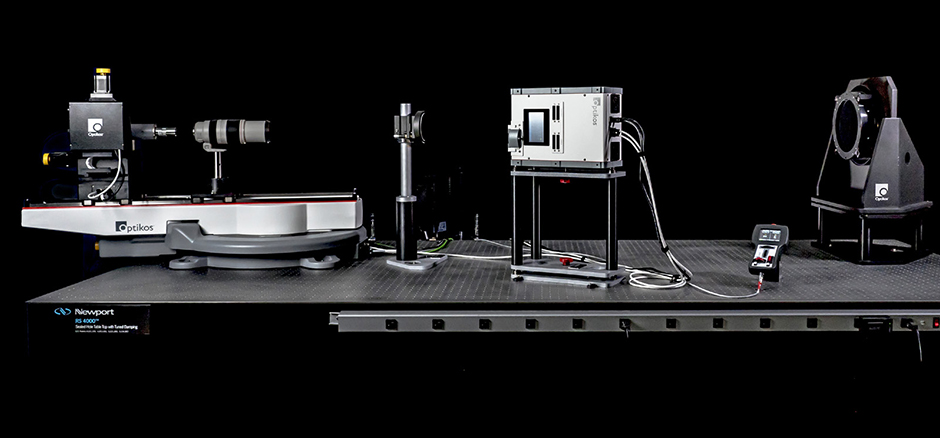
The design and manufacturing philosophy of the OpTest® series is that no matter what optical system you design, you can use the OpTest® system for testing and evaluation.
The OpTest® lens measurement system offers a customized solution for every step of the process. By integrating the latest technologies and innovations in optics and optomechanical engineering, OpTest® comprises customized optical components, mechanical parts, and electronic components specifically designed for lens testing by Optikos engineers. This comprehensive system provides the most extensive lens testing product line, along with upgrade plans and modules that can expand OpTest's metrology capabilities to include measurements such as transmittance, stray light, afocal, finite conjugate, and ultraviolet testing.
-
Main Features
·Customization: Advanced design tailored for applications
·Timely integration of the latest technological advancements: updates in component manufacturing, electromechanical systems, and detectors
·Upgrade flexibility: Provides a modular upgrade path for the future, balancing technological progressiveness and cost
·Multifunctional measurement module: stray light, thermal environment simulation, multi-wavelength, etc
-
OpTest® configurable optical system measurement solution

The modular components of the OpTest® system can be appropriately configured to test most types of lenses. To select and configure the modules suitable for the optical system under test, it is necessary to clarify the usage method of the optical system under test, with the following main factors to consider:
·Conjugate positional relationship between object and image
·Spectral range
·Spatial resolution
·The dimensions of the object and its image, as well as the field of view of the system
·Pupil diameter, F-number, and numerical aperture
·Appearance dimensions and optical system layout
1.Conjugate position of object and image: Most optical systems can be divided into three categories:

1.1 Infinite conjugate system: The object plane is located at infinity. For example: camera lens, eyepiece, infinity-corrected microscope objective.

1.2 Aseptic system: Both the object plane and the image plane are located at infinity. Examples include telescopes, binoculars, and beam expanders.

1.3 Finite conjugate system: Both the object plane and the image plane are located at a finite distance. Examples include photographic magnifying lenses, macro lenses, fiber optic panels, imaging tubes, and lithographic lenses.
2. Spectral range: The image analyzer of the OpTest® system can operate within the spectral wavelength range from UV to LWIR.

3. Spatial resolution: The imaging capability of all optical systems is primarily limited by two factors: their inherent theoretical diffraction limit and aberrations caused by system design or manufacturing defects. For systems used in optical testing and evaluation, their residual aberrations must be smaller than those of the system being tested. The image analyzer in the testing system must also have sufficient resolution to analyze the images formed by the optical system being tested. For infinite conjugate and finite conjugate systems, spatial resolution is specified in terms of the number of line pairs per mm; for afocal systems, it is specified in terms of the number of cycles per milliradian.
4. Image and object size, as well as system field of view: The test system must be capable of covering the field of view of the system under test in both object space and image space. For infinite conjugate systems, the test system must cover the angular field of view in object space and the linear dimensions of the full field of view image height. For testing finite conjugate systems, the translation stage must be able to cover the entire object height and image height, and set the required object distance. For testing afocal systems, it is necessary to span the angular field of view in both object space and image space.
5. Pupil diameter, F/number, and numerical aperture: The test system must be capable of covering the entrance pupil of the system under test in the object space and collecting light from the entire exit pupil. For the tested infinite conjugate and afocal systems, the entrance pupil diameter sets the lower limit of the required collimated beam size in the object space. The exit pupil diameter of the afocal system defines the requirements for the image space, while the F/number or numerical aperture is relevant when testing infinite conjugate or finite conjugate systems.
6. Physical Dimensions and System Layout: An OpTest® system necessitates an optical platform to house system components and employs a folded optical path. The optical system under test may be bulky or may incorporate a folded optical path or other unique physical features. The OpTest® system mandates the presence of 1/4 - 20 threaded holes with a center-to-center distance of 1 inch, or M6 holes with a center-to-center distance of 25 mm, on the platform.