




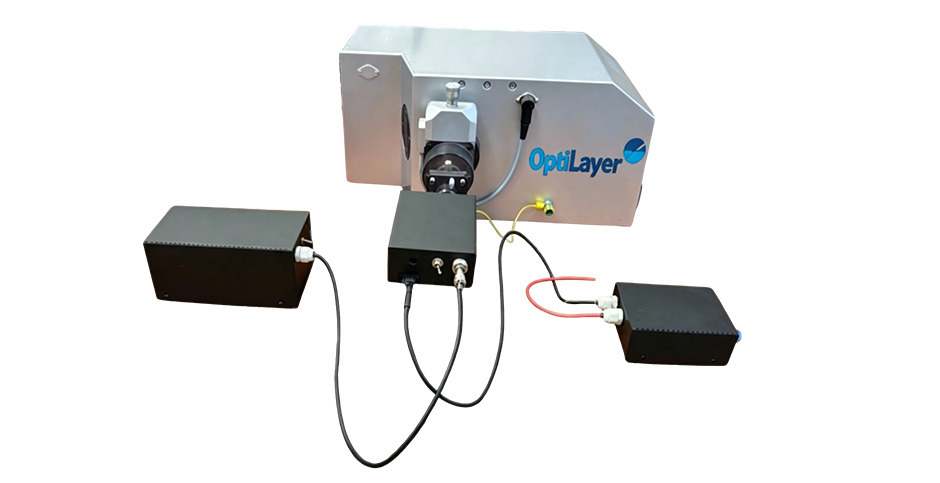
For decades, OptiLayer has been leading the design, characterization, and monitoring standards for multilayer optical films. Nowadays, its professional capabilities have extended to measuring hardware itself. OptiLayer monochromator is a high-precision instrument developed specifically for optical thin film deposition, integrated with OL Monitor software to form a closed-loop system for measurement and film termination decision-making.
In single spectrum monitoring, the termination decision of each layer depends on the small changes in transmittance or reflectance during the thin film deposition process. Electrical noise and measurement drift can be directly converted into thickness errors, which can cause the film to exceed the specification range. OptiLayer monochromators have been designed to provide pure, stable, and high-precision signals from the beginning - ensuring that your monitoring strategy is executed exactly as expected.
-
Advantages and FeaturesWide spectral coverage range: The working band of a single instrument is 180-3600 nm, covering the deep ultraviolet, visible light, near-infrared, and mid infrared regions.Flexible grating configuration: Adopting optimized Czerny Turner optical scheme, up to 4 diffraction gratings can be installed to meet different band requirements.Ultra low noise electronic design: equipped with precision voltage regulators to control power noise at 11-15 µ V, ensuring a clean and stable baseline.High measurement accuracy: The measurement error of spectral characteristics is only 0.01%, suitable for precision monitoring applications.High resolution wavelength control: The resolution can be as low as 0.15 nm or below.Fine wavelength tuning: The wavelength tuning repeatability reaches ± 0.017 nm, and the grating rotation step size is 0.009 nm, achieving precise signal control.Seamless software integration: Use it directly with OptiLayer's OL monitor software via high-speed USB.Full process automation: Measurement data is directly input into monitoring software to achieve a complete workflow from data acquisition to membrane termination.
-
Technical Specifications Table
Optical system
Optical scheme Optimized Czerny–Turner, one optical input and two outputs Spectral range (typical) 190 – 3600 nm Operating range 180 – 3600 nm Monochromator spectral bandwidth 0.2 – 25.2 nm F/number 1 : 3.8 Focal length 284 mm Flat field 30 × 10 mm Imaging Optional; available on both output ports Diffraction gratings 50 × 50 × 10 mm; single grating or a turret with 4 gratings Diffraction gratings
Parameter Grating1 Grating2 Grating3 Grating4 Grooves/mm 1800 1200 600 300 Reciprocal linear dispersion (avg.), nm/mm 2.12 3.18 6.37 12.64 Blaze wavelength, nm 270 400 750 2000 Spectral range, nm 190–540 265–800 500–1500
1330–3600 Multichannel array bandpass (avg.), nm 51 76 150 160 Resolution (avg.), nm <0.15 <0.22 <0.45 <0.94 Wavelength tuning accuracy, nm ±0.067 ±0.1 ±0.2 ±0.4 Wavelength tuning repeatability, nm ±0.017 ±0.025 ±0.05 ±0.1 Step of grating rotation, nm 0.009 0.013 0.026 0.05 Scanning rate, nm/s 16.7 25 50 100 Slits slit
Entrance / exit slits Automatic and manual adjustment Slit width 0 – 2 mm Slit height 12 mm Parallelism ±1 µm Micrometer reading accuracy ±1 µm Step size 0.001953125 mm Precision ±1 µm Filter wheel
Filter wheel Automatic switching Max number of filters 6 Standard number of filters 5 Filter size 20 mm Light aperture 18 mm Integrated shutter Program-controlled; for dark-signal measurement Electronics&Measurement Electrical Parameters
Power supply Precision voltage regulator, noise level 11–15 µV Amplifier power supply 24 V Spectral characteristic measurement error 0.01% Interface&Physical Interface and Dimensions
Computer interface High-Speed USB Dimensions 410 × 252 × 213 mm Weight 23.5 kg Software integration OL Monitor