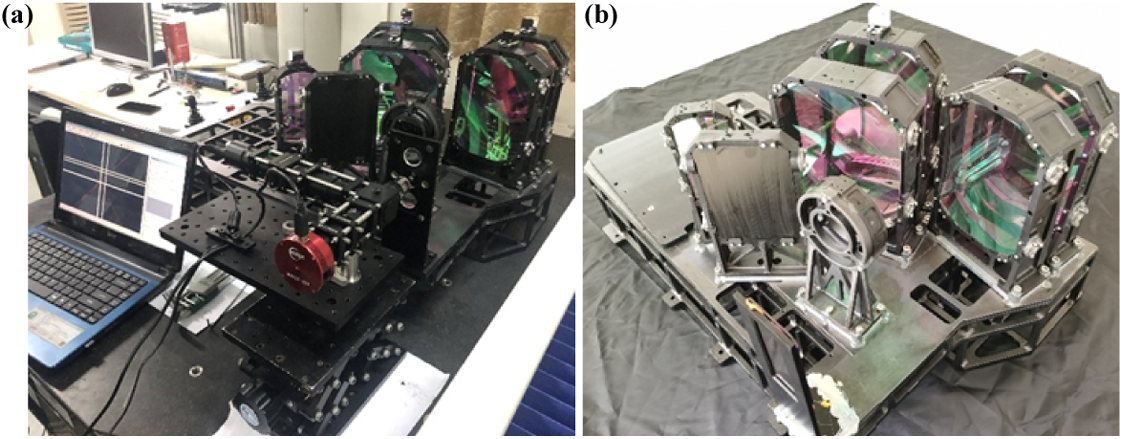



PSM is used for the installation and adjustment of spatial spectral cameras
Space dispersive spectrometers are widely used in environmental, resource, and ocean observations. Encoding spectrometers have higher energy advantages than dispersion spectrometers, therefore they have broad application prospects. In the current research, we have developed an off-axis short wave infrared coding optical system (SICOS) based on surface prism dispersion, and further explored the design and optimization of the SICOS structure. Finite element analysis was conducted on the SSICS-CPD spatial shortwave infrared coding spectrometer based on surface prism dispersion, including static simulation, modal analysis, sinusoidal vibration mechanical analysis, and random vibration mechanical analysis. The simulation results indicate that the SICOS support structure has excellent mechanical and thermal stability. Due to the inability of off-axis optical systems to meet optical position accuracy requirements through centering processing, high-precision and rapid assembly of SSICS-CPD was achieved using a point source microscope and a coordinate measuring machine. In addition, validation tests were conducted on surface shape errors, stress release, random vibrations, and optical design parameters to verify the high stability and imaging performance of SSICS-CPD. The results indicate that the average modulation transfer function across the entire field of view is 0.43 at 16.67 lp/mm, with spectral smile<0.2 pixels and spectral cornerstone<0.1 pixels. The design, analysis, assembly, and validation of SSICS-CPD provide useful references for the development of other spatial prism dispersion spectrometers.
Article details:



 2024-11-28